
Hydroseeding & erosion control · Metro Atlanta, GA
Atlanta Hydroseeding — licensed local crews, free quotes, honest pricing
We hydroseed lawns, slopes and commercial sites across metro Atlanta ourselves — licensed, insured, and GSWCC-certified for permitted work. Tell us about your property and we'll give you a free, no-obligation on-site quote.
Get a free quote
Four fields. We call you back the same working day.
Why hydroseeding
Built for the hardest soil in the Southeast
Hydroseeding is hydraulic seeding: grass seed suspended in a thick, tinted slurry of wood or paper mulch, starter fertilizer, soil amendments and a tackifier, sprayed onto prepared ground under pressure. The mulch holds moisture against the seed for the two weeks that decide whether a lawn succeeds. The tackifier glues the whole blanket to the soil so a July thunderstorm doesn't take your investment down the driveway.
That matters more here than almost anywhere. Metro Atlanta sits on Piedmont red clay — dense, low in organic matter, prone to sealing into a hard crust after grading. Dry broadcast seed lands on that crust, dries out by noon, and washes into the storm drain. Sod hides the problem: a pallet of turf laid on unamended clay often stays root-bound at the seam for a full season, then thins out under the first drought.
A hydroseed slurry works with the clay instead of covering it. A competent crew breaks the crust, amends and pH-corrects where the soil test calls for it, then applies a blend chosen for your specific exposure — certified Bermuda for full sun and heavy traffic, turf-type tall fescue for the shaded north-side lots common in Decatur and Sandy Springs, zoysia where a fine-bladed premium look is worth the slower fill-in, and native/annual cover mixes where the job is holding a bank until permanent vegetation establishes. Roots grow down into native soil from day one, so the lawn that comes in is deeper-rooted and more drought-tolerant than one you unrolled.
Hydroseeding vs. sod vs. traditional seeding
Ranges below reflect typical installed pricing in the Atlanta metro. Your quote depends on site conditions.
| Hydroseeding | Sod | Traditional (dry) seeding | |
|---|---|---|---|
| Installed cost | $0.08–$0.20 / sq ft | $0.55–$1.20 / sq ft | $0.03–$0.08 / sq ft |
| First green | 7–14 days | Immediate | 14–28 days, patchy |
| Ready to mow | 3–4 weeks | 2–3 weeks | 5–8 weeks |
| On slopes | Excellent to ~2:1 with tackifier or bonded fiber matrix | Needs staking; seams lift and slide when saturated | Poor — seed washes off in the first hard rain |
| Root system in clay | Grows into native soil from germination; no interface layer | Can stay root-bound at the sod/clay seam for a season | Uneven; thin stands need reseeding |
| Best for | Whole lawns, new construction, acreage, slopes, erosion permits | Instant use, small showcase areas, immediate resale photos | Small flat patches on a tight budget |
Services
What our crews handle
Residential hydroseeding & new lawn installation
Full-yard installs and complete lawn renovations. Crews grade out ruts, correct pH, and match the seed blend to your sun exposure so the lawn reads uniform from the street — not a patchwork of whatever was left on the truck.
Commercial hydroseeding
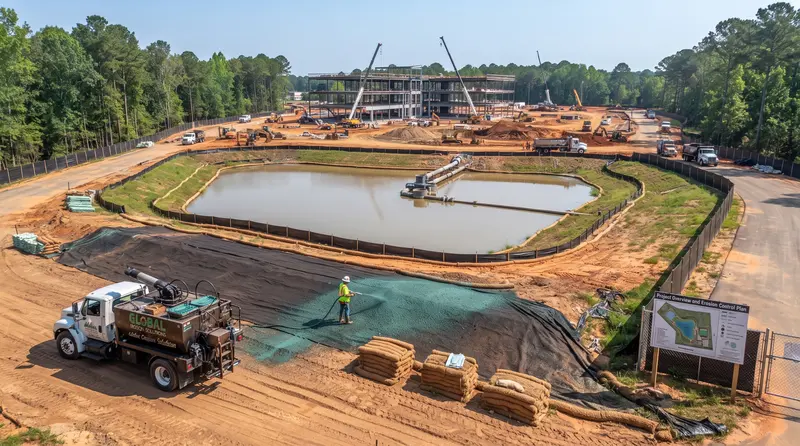
Subdivisions, industrial pads, detention ponds, solar sites, athletic fields and roadway shoulders. Tank capacity and crew scheduling sized for multi-acre days, with documentation your GC or inspector can file.
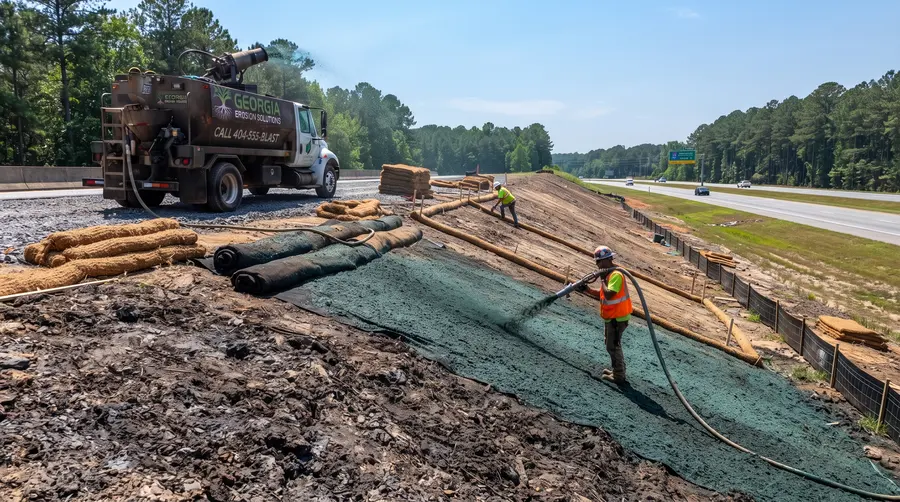
Erosion control & slope stabilization
Tackified hydromulch and bonded fiber matrix on cut banks, fill slopes, pond embankments and stream buffers — the fastest legitimate route to vegetative cover on an NPDES-permitted site.
Bare patch & lawn repair
Shade thinning, dog runs, utility trench scars, fungus damage and washed-out swales. Small-job pricing with the same slurry and the same certified seed used on full installs.
New construction lot seeding
Builders and custom-home clients: final grade to green cover, coordinated around punch-list dates so the lot passes inspection and photographs well at closing.
Grading, BMP install & sod
Our crews also handle the work that surrounds the seed: finish grading, silt fence and BMP installation for permitted sites, and sod installation when a project genuinely calls for instant turf instead.
How it works
From one form to a mowable lawn
STEP 01
Tell us about the property
Two minutes on the form or one phone call: square footage, slope, timeline, and whether the site is residential, commercial or under an erosion permit.
STEP 02
We schedule your visit
We call to confirm the details and get one of our crews out to the property — usually within a day or two, sooner for time-sensitive erosion or permit work.
STEP 03
Free on-site assessment
Our crew walks the property, measures, reads drainage and sun exposure, checks compaction and pulls a soil sample where it changes the recommendation. You get a written scope and a fixed price.
STEP 04
Prep, blend & application
Debris and ruts cleared, clay crust broken, lime and amendments applied to soil-test numbers. Then certified seed, mulch, fertilizer and tackifier sprayed at a uniform rate — the green tint makes coverage visible before the hose goes away.
STEP 05
Watering & aftercare plan
A one-page schedule tuned to your irrigation setup: short frequent cycles for weeks one to three, then tapering to deep soakings. First mow height, first fertilizer date, and what normal germination looks like.
STEP 06
Follow-up — both ways
Our crew checks in after germination and near the first mow. We check in with you too: if we fall short of our written quote, we make it right.
Pricing
What hydroseeding actually costs in Atlanta
Nobody else in this market will publish a number. Here are honest ranges so you can budget before you pick up the phone. Every project still gets a free on-site quote with a fixed price — these bands are for planning, not a substitute for measuring your yard.
Small residential
$500–$1,200
Up to ~5,000 sq ft. Patch work, front yards, townhome lots. Minimum trip charge applies.
Standard lot
$1,200–$2,800
5,000–15,000 sq ft. The typical full front-and-back install on a metro Atlanta subdivision lot.
Acreage & commercial
$3,000–$9,000
Half an acre to two acres. Per-square-foot rate drops as area goes up; multi-acre sites quoted by the acre.
Slope & erosion control
$0.15–$0.35 / sq ft
Tackified hydromulch and bonded fiber matrix. Priced by product loading rate and slope access.
What moves the price
Total square footage and how much of it the truck can reach with hose. Slope and the tackifier or BFM loading it requires. Seed blend — certified zoysia costs multiples of a contractor fescue mix. Prep work: grading, tilling, rock and debris removal, lime and amendments. Water access on site. Whether the job carries permit or inspection requirements.
Compared to sod
On a 10,000 sq ft lawn, hydroseeding typically lands between $1,200 and $2,400 installed. The same area in sod runs $5,500 to $12,000. You trade two to three weeks of waiting for a lawn that costs a quarter as much and roots deeper into the clay.
Before & after
Real Atlanta projects, real timelines
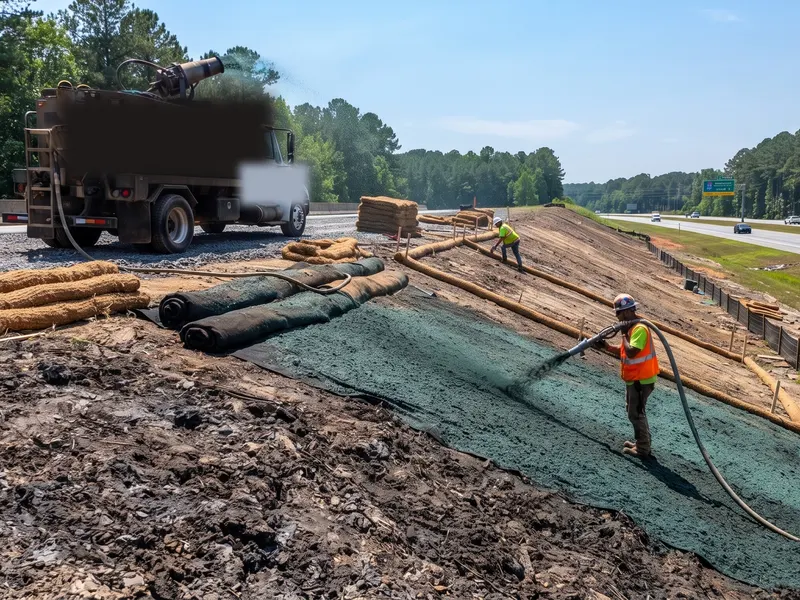
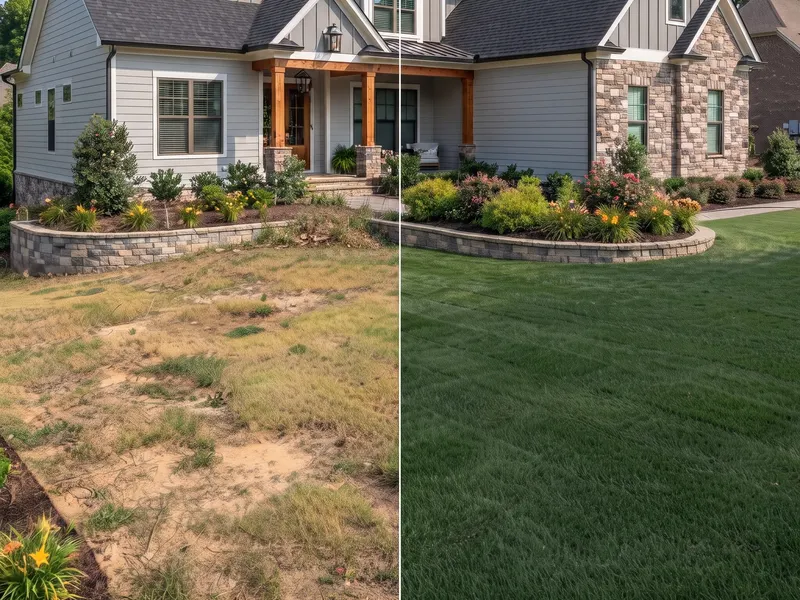
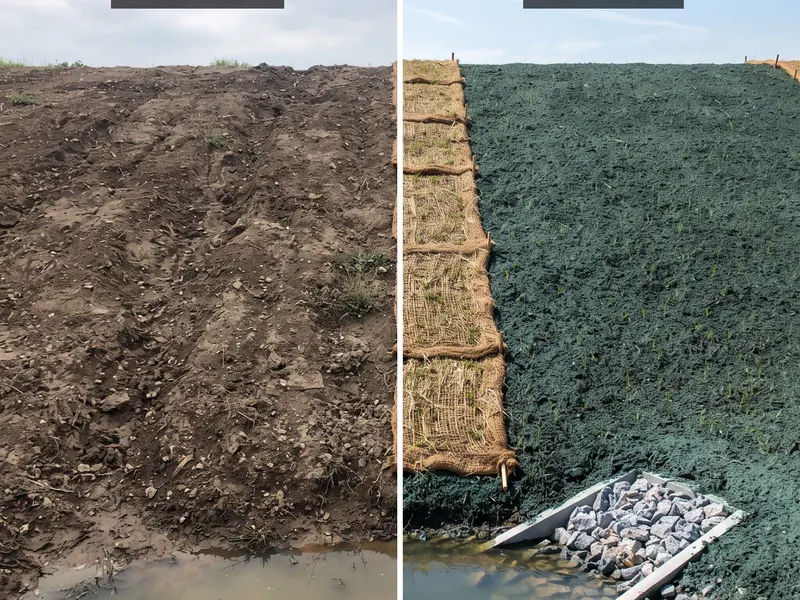
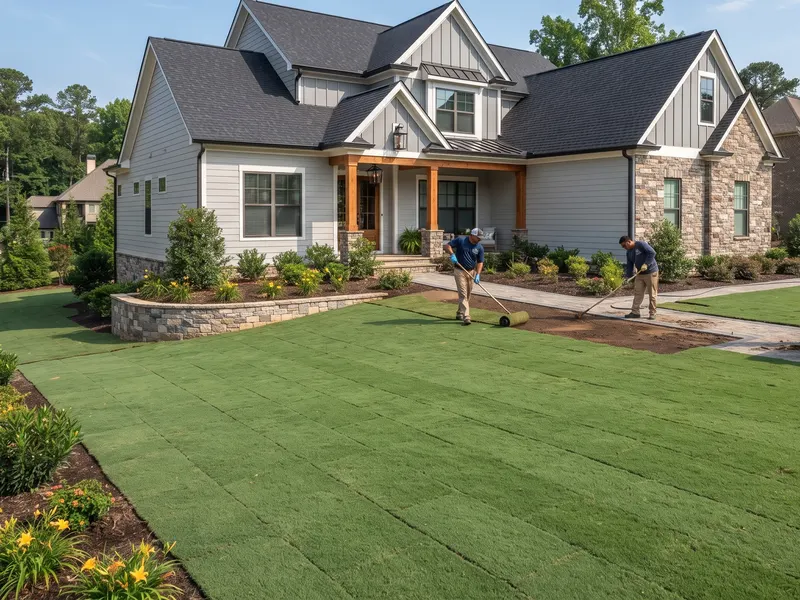
Recent work from our crews — bare clay on day one, established turf on the day it was first mowed.
Our standard
Every job we take on meets this bar
Hydroseeding is a trade where the difference between a lawn and a bill shows up three weeks after the crew leaves. Our own crews do the work, so these five standards are ours to keep — not a subcontractor's.
Licensed and insured — verified
We carry general liability and workers' comp coverage and keep both current every year. Ask for a copy with your quote and you will get one.
GSWCC-certified for permitted work
Erosion and sediment control on a permitted site legally requires Georgia Soil & Water Conservation Commission certification. Our crews hold it for every permitted job that requires it.
Written, fixed-price quotes
No verbal ballparks and no square-footage surprises after the truck arrives. Every quote spells out the seed blend, the application rate and exactly which prep work is included.
Germination guarantee, with dates
Germination is expected within 10 to 21 days, with a final evaluation window around 30 to 35 days. Our re-spray guarantee — and the watering conditions that apply to it — is stated on every written quote.
Complaints actually go somewhere
If we don't show, don't honor our written quote, or leave a lawn short, tell us. Call (678) 264-6886 and we'll make it right.
Before you hire
Seven questions to ask any hydroseeding contractor
Ask us these seven questions — and any other hydroseeding contractor you're considering. A company that answers all seven without stalling is usually worth hiring.
01
Can I see your certificate of insurance?
General liability and workers' comp, current, with your name addable as a certificate holder. Hesitation here usually means uninsured.
02
Are you GSWCC-certified, and at what level?
Only matters on permitted or disturbed-acreage sites — and there it is the law, not a preference. Ask for the level and the card.
03
What exact seed blend and rate are you using?
Cultivar name and pounds per thousand square feet, in writing. "Contractor mix" is how cheap annual rye ends up in your yard.
04
Is a tackifier included on the slope?
Anything steeper than roughly 4:1 needs tackifier or a bonded fiber matrix. Without it, the first Georgia downpour takes the job with it.
05
What prep work is in the price?
Grading, tilling, rock and debris removal, lime and amendments. Prep is where two quotes silently differ by a thousand dollars.
06
What happens if it does not come in?
Get the re-spray policy in writing, including the watering conditions that void it and the evaluation date it is measured on.
07
Who is actually doing the work?
The person quoting, an employee crew, or an unnamed sub? Ask — and ask whose insurance covers them on your property. (Ours does — our crews are our own.)
Service area
Hydroseeding across metro Atlanta
Our crews cover roughly a one-hour radius around the Perimeter, inside and out. If your town isn't listed, send the form anyway — we travel further for acreage jobs.
FAQ
Hydroseeding questions, answered straight
How long does hydroseeding take to grow grass in Georgia?
Germination is typically 7–14 days in warm weather and 14–21 days when soil temperatures drop. Most lawns take a first mow at three to four weeks and knit in fully by the end of the second growing season. Bermuda spreads laterally and fills faster than fescue.
Is hydroseeding cheaper than sod?
Substantially. Installed hydroseeding runs about $0.08–$0.20 per square foot against $0.55–$1.20 for sod in this market. On a 10,000 sq ft lawn that's a difference of several thousand dollars — you're paying with three weeks of patience instead.
What time of year is best for hydroseeding in Atlanta?
Warm-season grasses (Bermuda, zoysia) go down from late April through early August, once soil temperatures hold above 65°F. Cool-season fescue blends do best mid-September through late October, with a narrower spring window in March. Erosion-control hydromulch can be applied year round.
Do I need to water hydroseeded grass every day?
For the first two to three weeks, yes — short cycles two or three times a day to keep the mulch damp, not soaked. After germination, taper to deeper and less frequent watering so roots follow moisture down into the clay instead of sitting at the surface.
Does hydroseeding work on slopes and for erosion control?
It's one of the best tools available. A tackifier or bonded fiber matrix bonds the slurry to the soil surface so it survives Georgia downpours on grades up to roughly 2:1 — where broadcast seed washes out and sod seams lift and slide once saturated.
How much does hydroseeding cost in Atlanta?
Most residential projects fall between $500 and $2,800 depending on square footage, slope, prep and seed blend; acreage and erosion work is priced per square foot. See the pricing section for full bands. Quotes are free and on site.
What's the difference between hydroseeding and regular grass seed?
Broadcast seeding drops dry seed on bare ground and hopes. Hydroseeding delivers each seed inside a moisture-holding, wind-resistant mulch blanket with starter fertilizer already in contact with it. Germination rates are far higher in compacted red clay, and coverage is visibly uniform.
Are you a hydroseeding company or a matching service?
We're a hydroseeding company. Our own licensed and insured crews handle every project across metro Atlanta, from the site visit through application and aftercare — nothing gets handed off to a subcontractor. On-site assessments and quotes are free, with no obligation.
Which seed blend is right for my yard?
Full sun with kids or dogs: certified Bermuda. Four hours of sun or less, common on wooded metro lots: turf-type tall fescue. Premium fine-bladed look and patient owner: zoysia. Bank or buffer holding until permanent cover: a native and annual cover mix. The crew recommends on site, not over the phone.
Free quote
Tell us about your property
Send the form or call. We'll come measure the property, read the soil and the drainage, and give you a fixed price in writing — no charge, no pressure.
Phone
(678) 264-6886Hours
Monday–Friday, 8:00am–6:00pm
Office
642 North Ave NW
Atlanta, GA 30318
Coverage
Metro Atlanta, Georgia — 21 suburbs inside and outside the Perimeter.